Streaming thrillers have become louder over the last decade. Heavy orchestral scores, sudden musical cues, and nonstop tension music now dominate many crime dramas and hostage films. Yet iHostage takes a quieter path. The Netflix thriller relies on restrained audio choices, sparse music placement, and long stretches of silence to create unease. That decision gives the movie a very different emotional texture compared to many modern streaming releases.
Discussion surrounding iHostage (2025) on Netflix has focused heavily on the film’s realism and psychological tension. Much of that atmosphere comes from the soundtrack itself. Music publication Vague Visages noted that the movie uses only a handful of featured songs, allowing ambient sound and silence to carry much of the suspense instead. Rather than overwhelming viewers with dramatic scoring, the film lets small sounds, footsteps, breathing, and background movement create emotional pressure.
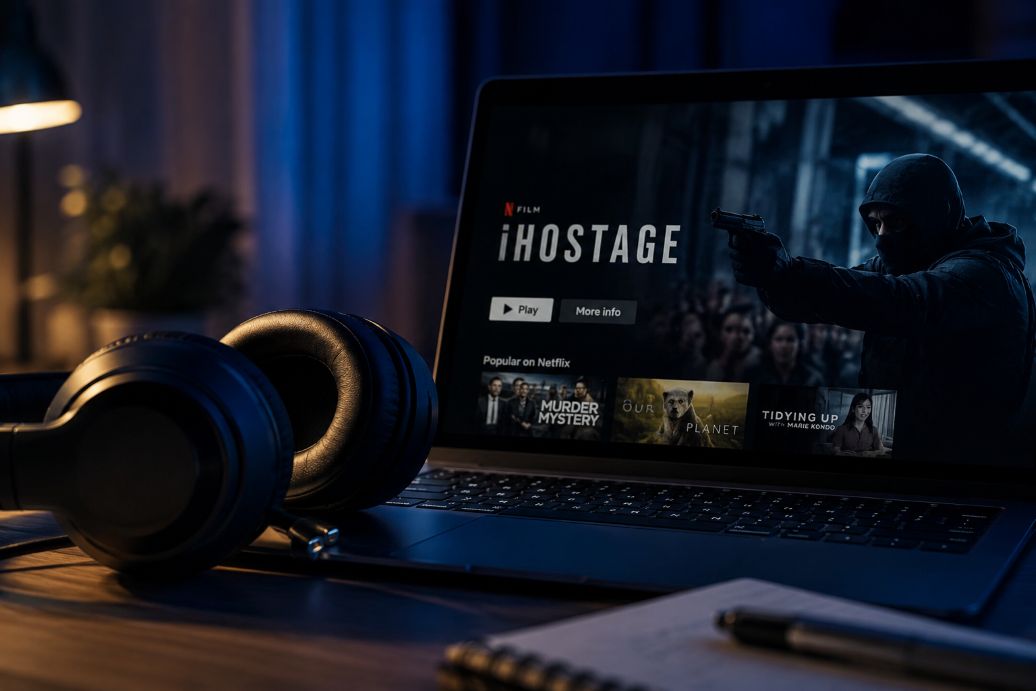
Why the Soundtrack Feels Different From Many Netflix Thrillers
Many streaming thrillers treat music as a constant emotional guide. Scenes are often filled with dark strings, rising percussion, or loud cinematic cues designed to tell viewers exactly how to feel. Research from the University of Southern California’s School of Cinematic Arts has explored how modern film scoring shapes emotional response by signaling fear, urgency, or danger before audiences consciously recognize it.
iHostage avoids that approach for much of its runtime. Silence becomes part of the storytelling. Several scenes feel uncomfortable precisely because there is no music underneath them. Viewers are left listening to room tone, crowd noise, or tense breathing patterns instead of dramatic orchestration.
That restraint creates realism. During high-stress situations in real life, moments rarely come with cinematic music attached. The film seems aware of that. Its sound design often feels closer to documentary filmmaking than traditional Hollywood thrillers.
“If You Don’t Want My Love” Creates an Uneasy Calm
The opening musical moment comes through Jalen Ngonda’s soulful track “If You Don’t Want My Love.” The song plays as the main character arrives in Amsterdam, creating a calm and reflective atmosphere before the crisis unfolds.
That choice matters because it immediately establishes emotional contrast. The warmth of the song clashes with the tension that slowly develops afterward. Music experts from Berklee College of Music have often discussed how contrast in film scoring can increase emotional impact more effectively than constant intensity. Calm music placed before chaos can make suspense feel more unsettling.
Ngonda’s vintage-inspired sound also gives the opening scenes a human quality. Instead of signaling danger immediately, the movie allows viewers to settle into the character’s environment. That slower emotional setup makes later scenes feel more disruptive. Themes connected to personal storytelling in modern music help explain why emotionally grounded songs can feel more powerful in tense films than large cinematic scores. The track itself is not aggressive or dramatic. It carries softness and melancholy, which helps the audience connect emotionally before the hostage situation escalates.
The track itself is not aggressive or dramatic. It carries softness and melancholy, which helps the audience connect emotionally before the hostage situation escalates. Small creative decisions like this help explain why the film’s atmosphere feels grounded rather than exaggerated.
Why “Feeling Good” Becomes So Memorable
Michael Bublé’s version of “Feeling Good” appears multiple times throughout the film, including scenes connected to the hostel and Apple Store environment. The song eventually returns during the ending and credits, giving it unusual emotional weight.
On paper, the choice feels unexpected. “Feeling Good” is polished, upbeat, and confident. It is widely associated with elegance and optimism. Yet placing it inside a tense hostage thriller creates irony. The title itself almost feels emotionally disconnected from what viewers are watching on screen.
That contrast is likely intentional. Film scholars from the British Film Institute have long pointed out that ironic music placement can create psychological discomfort because it forces audiences to process two conflicting emotional signals at the same time.
Rather than using dark suspense music, the film occasionally leans into emotional contradiction. Viewers hear smooth jazz-pop vocals while anxiety continues building underneath the scene. The result feels strange, memorable, and deeply unsettling.
The repetition of “Feeling Good” during the ending also changes how audiences interpret the song. By the time the credits roll, the track no longer sounds carefree. It carries emotional residue from the events viewers just experienced.
Silence Functions Like an Invisible Character
Despite the attention given to the featured songs, silence remains the movie’s most important audio tool. Long pauses between dialogue lines create uncertainty. Empty background spaces make viewers hyper-aware of small noises. A closing door or distant alarm suddenly feels significant.
Studies published through the Journal of Media Psychology suggest that reduced musical guidance can increase audience attention because viewers begin searching for emotional clues within the environment itself. That effect appears throughout the movie.
Several scenes rely heavily on ambient sound rather than score. Crowd movement, echoes inside buildings, and muffled conversations become part of the tension structure. Even moments of stillness feel loaded with anxiety.
That technique reflects a broader shift happening in streaming thrillers. Many filmmakers are moving away from nonstop soundtracks and toward more restrained audio storytelling. Viewers who binge-watch multiple shows often experience what critics describe as “sound fatigue,” where constant dramatic music starts feeling repetitive across productions.
Minimalist sound design offers an alternative. By reducing musical overload, films can make individual soundtrack moments feel more meaningful.
The Minimalist Score Supports the Film’s Realism
The original score for the movie was composed by Federico Lecuona Damborsky, while music supervision was handled by Mounir Hathout. Instead of dominating scenes, the score quietly supports the emotional atmosphere from the background.
That subtlety helps maintain realism. Loud scoring can sometimes pull audiences out of grounded thrillers because it reminds them they are watching a carefully constructed movie. A minimalist approach keeps attention focused on performances, dialogue, and emotional reactions.
Modern streaming audiences have also become more comfortable with slower pacing and restrained storytelling. Data from Nielsen has shown that psychological thrillers and grounded crime dramas continue performing strongly across streaming platforms, especially productions that emphasize realism and character tension over spectacle.
The soundtrack choices in this Netflix hostage drama fit directly into that trend. The movie trusts silence enough to let tension develop naturally. When music finally enters the scene, viewers notice it immediately.
Why the Soundtrack Leaves a Lasting Impression
The soundtrack of iHostage proves that suspense does not always require loud orchestration or constant dramatic scoring. Sometimes tension grows stronger when filmmakers allow silence to dominate the room. Sparse musical choices, emotionally contrasting songs, and restrained scoring create a more intimate viewing experience.
That may explain why conversations around the Netflix thriller continue focusing on its atmosphere long after the credits end. The film uses music carefully instead of continuously. Every soundtrack decision feels deliberate.
As more streaming thrillers experiment with minimalist sound design, productions like this may influence how suspense is built in future releases. Quiet storytelling can leave a deeper emotional mark than overwhelming noise. iHostage understands that balance, and its soundtrack becomes memorable precisely because it knows when to stay silent.